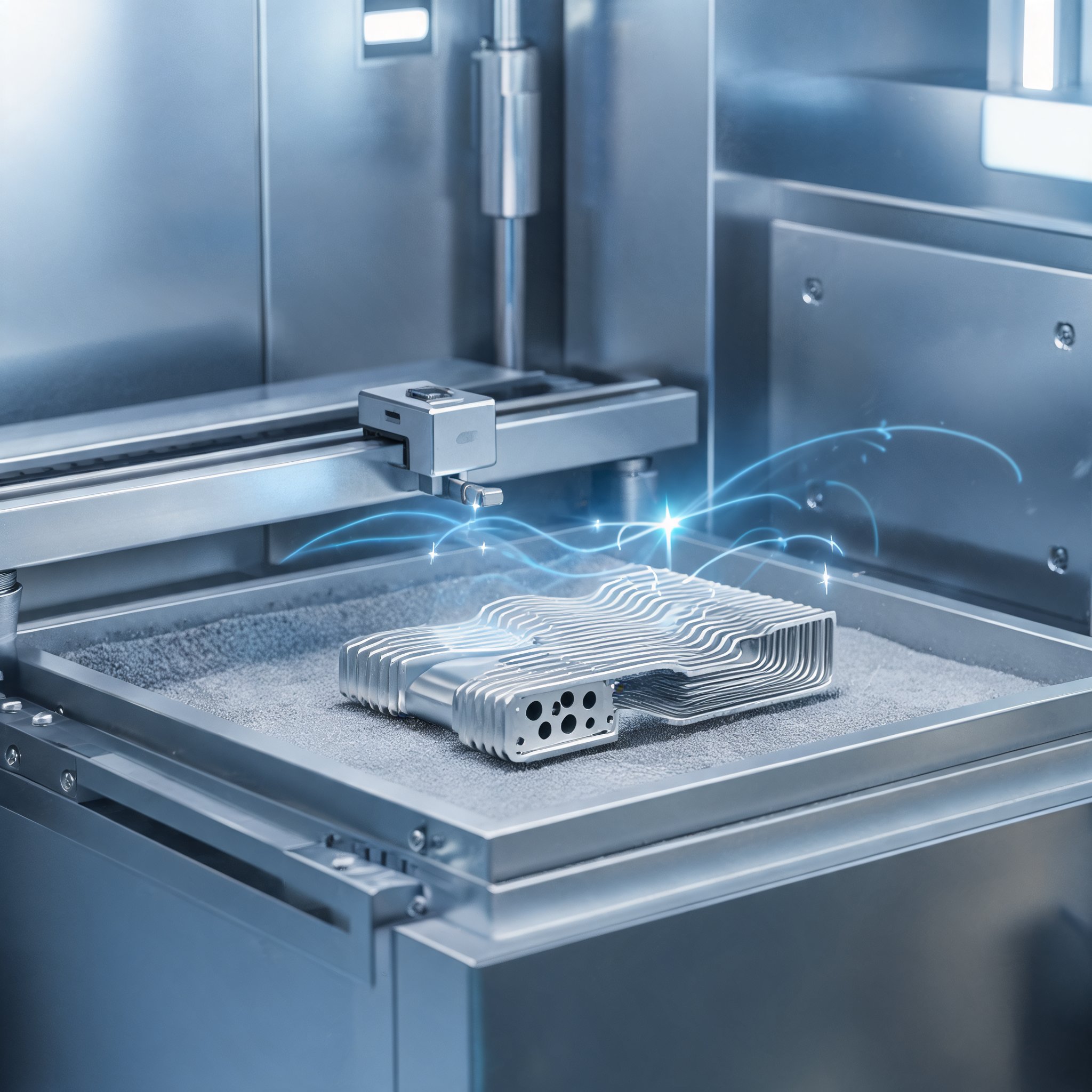
AMiquam, a Swiss technology company, reports advances in the sensitivity of its in-situ eddy current inspection technology for metal additive manufacturing, including detection of defects as small as 0.1 mm in thin-walled components made by laser powder bed fusion (LPBF). The company presented the developments in a technical publication ahead of Formnext 2026; the approach is intended to inspect parts layer by layer during production rather than relying only on post-build non-destructive testing.
Sensor integrated into the recoater
AMiquam's method uses an eddy current sensor integrated into the recoater assembly of an LPBF machine. As the recoater moves across the build platform, the sensor scans each newly deposited layer and records electromagnetic signals that can indicate internal defects. The inspection data is then mapped to the component geometry, allowing software to locate and report detected anomalies automatically.
Thin-wall heat exchanger test
One result focused on thin-walled structures used in additively manufactured heat exchangers. AMiquam used a 316L stainless steel test specimen with a wall thickness of 0.7 mm and demonstrated detection of five artificially introduced holes ranging from 0.1 mm to 0.5 mm in diameter. Both through-holes and blind holes produced distinct peaks in the eddy current signal, according to the company, and even the smallest 0.1 mm indication was distinguishable from background signal variations. Measurements were collected across approximately 127 layers, with each hole producing a corresponding signal peak as the build progressed.
According to AMiquam, the results point to the potential for inspecting complex structures such as triply periodic minimal surface (TPMS) heat exchangers, where internal channels and thin walls can make conventional post-process inspection difficult.
Blade structures and detection limits
A second application concerns LPBF-manufactured aeroengine blades, where different laser scanning strategies create distinct microstructures within the same component. The blade design uses a conformal laser scanning strategy in the surface skin, while the bulk material is made with a conventional chessboard scanning approach. AMiquam says these processing differences influence the microstructure and therefore the eddy current signals generated during inspection.
The company reports a defect detection capability of approximately 0.2 mm within the conformal skin. In the bulk material, the detection threshold is approximately 0.5 mm, where microstructure variations create additional signal fluctuations that can make smaller indications harder to distinguish. AMiquam notes that detection sensitivity depends on material characteristics, laser scanning strategy and component geometry, and that optimising laser strategies could potentially improve performance in bulk regions.
Location data and certificate concept
Beyond detection, the technology is designed to establish the precise location of defects within a manufactured component. Eddy current signals recorded during each recoating operation are mapped onto the part geometry, and software automatically identifies indications above predefined thresholds and assigns positions in X, Y and build-layer coordinates. AMiquam says this spatial information can help manufacturers identify where defects occur and support investigations into their origin, while data captured throughout the build could provide earlier insight into potential quality issues.
AMiquam also describes a concept for an inspection certificate containing material, layer coverage, detection limits and detected indications. The company presents this as an illustrative example rather than an actual component certification. It says the work highlights how established non-destructive testing principles can be adapted for in-process inspection in aerospace, energy and medical manufacturing, where qualification and traceability matter. Detection thresholds remain dependent on geometry, material and manufacturing parameters, and the reported results should be considered application-specific rather than universal performance limits.