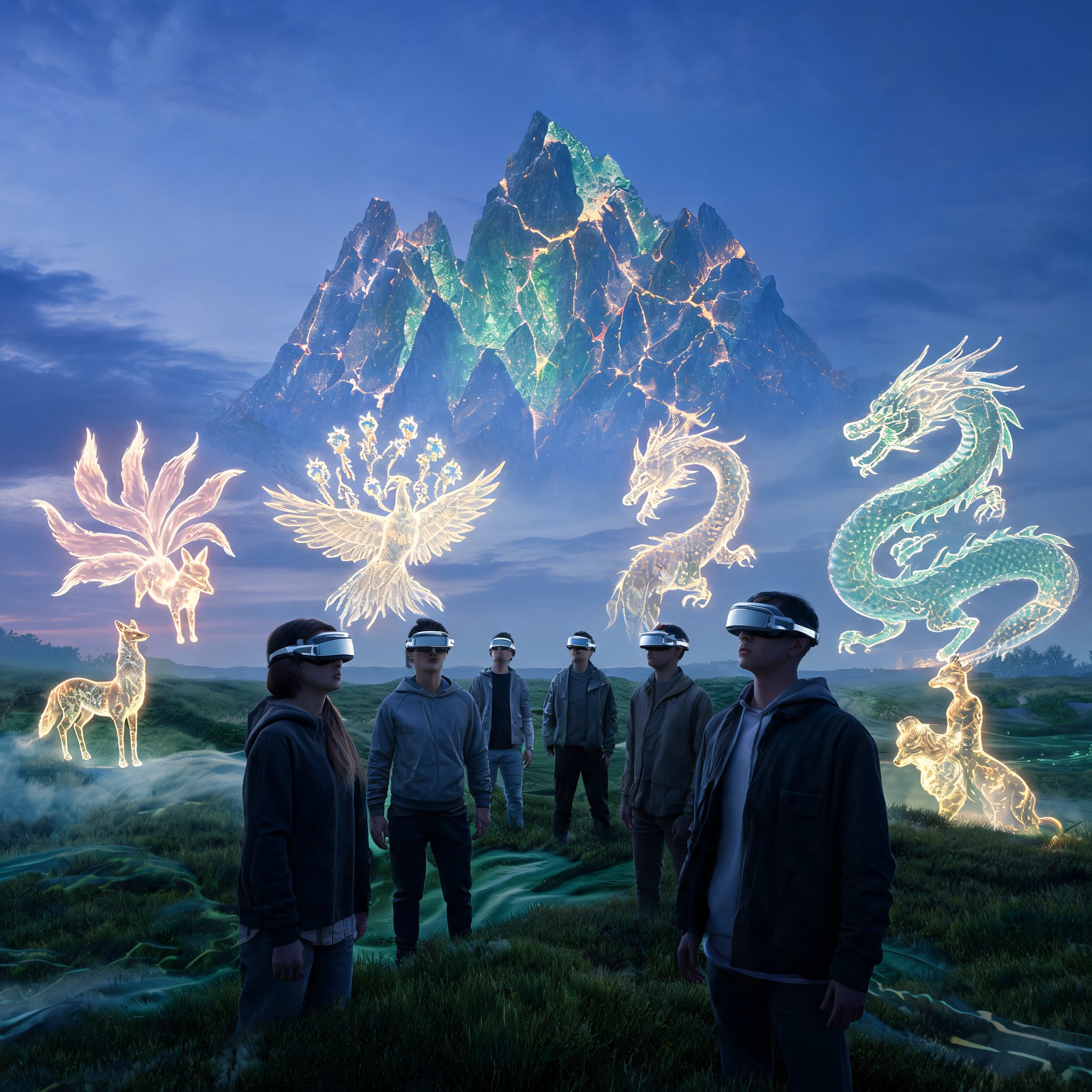
AStation's Shan Hai Jing is a mixed reality experience that turns the ancient Chinese myth collection into an outdoor walkthrough. Guests wear Apple Vision Pro headsets and move through up to 2,000 square metres of real outdoor space while seeing friends and their surroundings alongside a virtual mountain. AStation says as many as 120 guests can share the same space at once.
From written myth to shared space
Shan Hai Jing, or The Classic of Mountains and Seas, is a collection of myths that Chinese storytellers began writing down more than two thousand years ago. It includes stories of strange lands, strange animals and gods, among them the legend of Nuwa, a goddess who repairs a broken sky. AStation describes the collection as part of the bedrock of Chinese culture, comparable to Greek myths in Western culture, while noting that almost no one outside China knows them.
In the experience, guests see a mixed reality mountain where the adventure begins. A god, furious after losing a great battle, smashes his head into the mountain and breaks it. Because the mountain holds up the sky, the sky tilts and the earth drops to one side. AStation says ancient storytellers used the myth to explain what they saw in nature, including why China's rivers flow toward the sea and why the stars seem to wheel across the sky. Guests witness this, even seeing the ground tilt beneath their feet.
A realm of mythic creatures
From there, guests enter what AStation calls the "Realm of the Crumbling Sky." More than a dozen magical scenes appear, and hundreds of creatures from the old stories approach, including nine-tailed foxes, nine-headed birds, dragons and beings that are part human and part animal. As guests explore deeper, the creatures reveal more of the legend. AStation describes the result as walking inside a myth older than the Great Wall of China.
The experience relies on AStation's Enterverse technology, which blends the myths directly onto real outdoor space. AStation says it requires no wires, handheld controllers or indoor stage. The myth is not shown on a screen; it is built into the ground beneath guests' feet. Because groups share the space, they experience the sky breaking together rather than alone.
The value of repair
AStation also connects Shan Hai Jing to a value that still matters in Chinese culture. In the story, anger breaks the world, but Nuwa melts colourful stones to patch the sky and restore balance. For thousands of years, Chinese culture has returned to the idea that when something breaks, someone must take on the patient work of repairing it. AStation calls this harmony, or héxié (和谐), and says it still shapes how many Chinese people think of their duty to one another. The experience lets guests stand inside the moment the world breaks and feel why repairing it became one of China's oldest and most enduring values.
AStation links China's current cultural revival, in which parts of society are re-embracing ancient culture, to its rapid domestic growth. Culture and technology are both core pillars of China's current Five-Year Plan. AStation says Shan Hai Jing was produced entirely in-house, with no external partners.