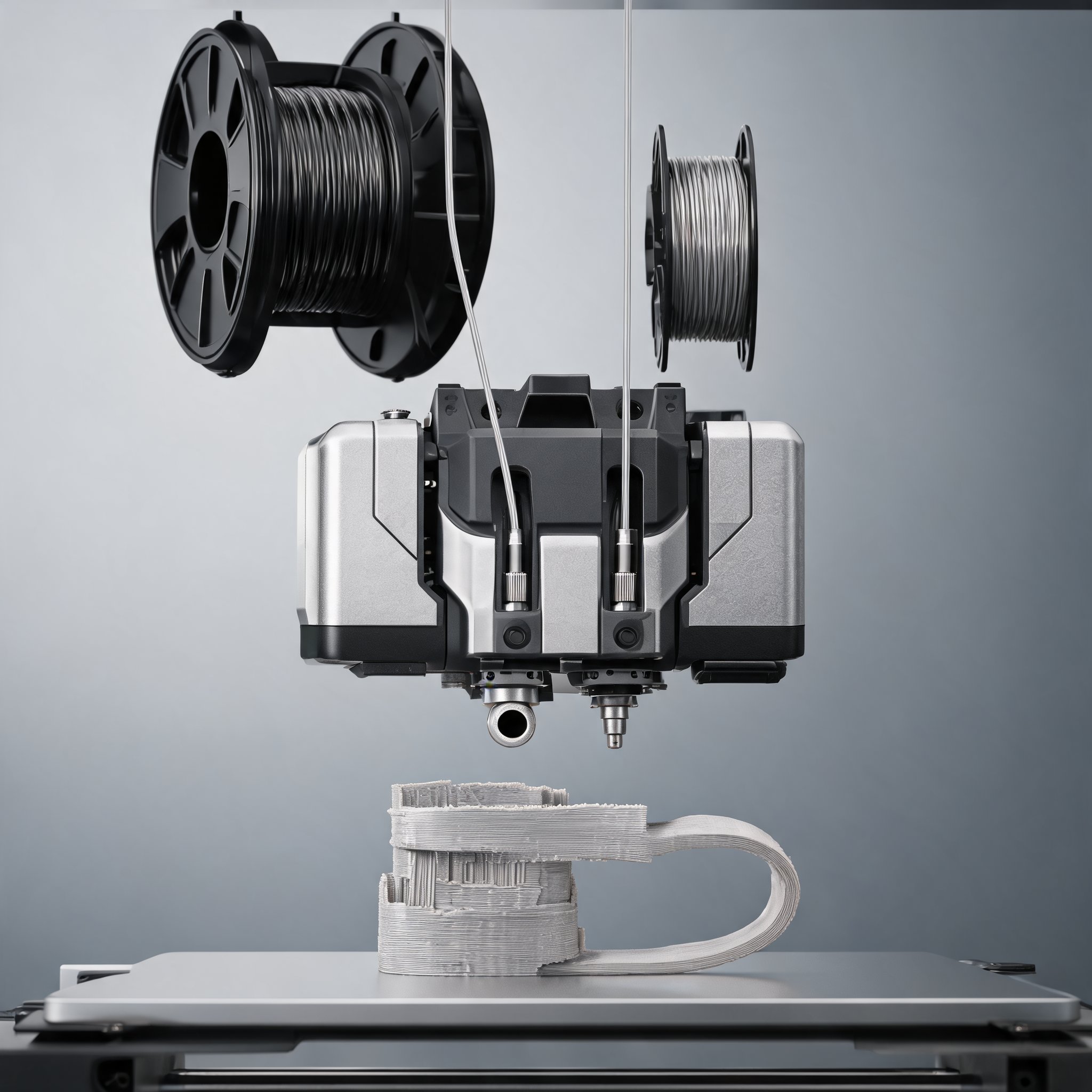
Bambu is revealing the features of its upcoming H3C 3D printer one at a time. After teasing multi-color printing, the company has shown a multi-component watch that points to mixed nozzle sizes and a second filament diameter within a single job.
The teaser image breaks the watch down into three parts:
- a 0.4 mm nozzle running 1.75 mm filament for the rigid case;
- a 0.2 mm nozzle running 1.75 mm filament for crisp detail;
- a 0.4 mm nozzle running 2.85 mm filament for the soft strap, described as likely TPU.
Two points follow from the breakdown
The first is that Bambu appears to be adding 2.85 mm filament compatibility, aimed at soft and rubbery materials such as TPU. The second, and more consequential, is the suggestion that 0.2 mm and 0.4 mm nozzles can be used in the same print, presumably in a job containing multiple objects.
That mixing has been a long-standing request from owners of Bambu's H2D and H2C printers, and probably the newer X2D as well. So far Bambu has not allowed users to combine 0.4 mm and 0.2 mm nozzles in one job — only a single nozzle can be selected — and software limitations are described as the obstacle on the existing dual-nozzle machines.
Whether mixed nozzle sizes will reach all compatible Bambu printers, or only the upcoming flagship H3C and P3C, is still open. The P3C has not been formally announced, though there is no obvious reason it would lack the same multi-nozzle and multi-diameter capabilities. A follow-up teaser video shows watch components printed in place as a single part using several nozzle and filament sizes.