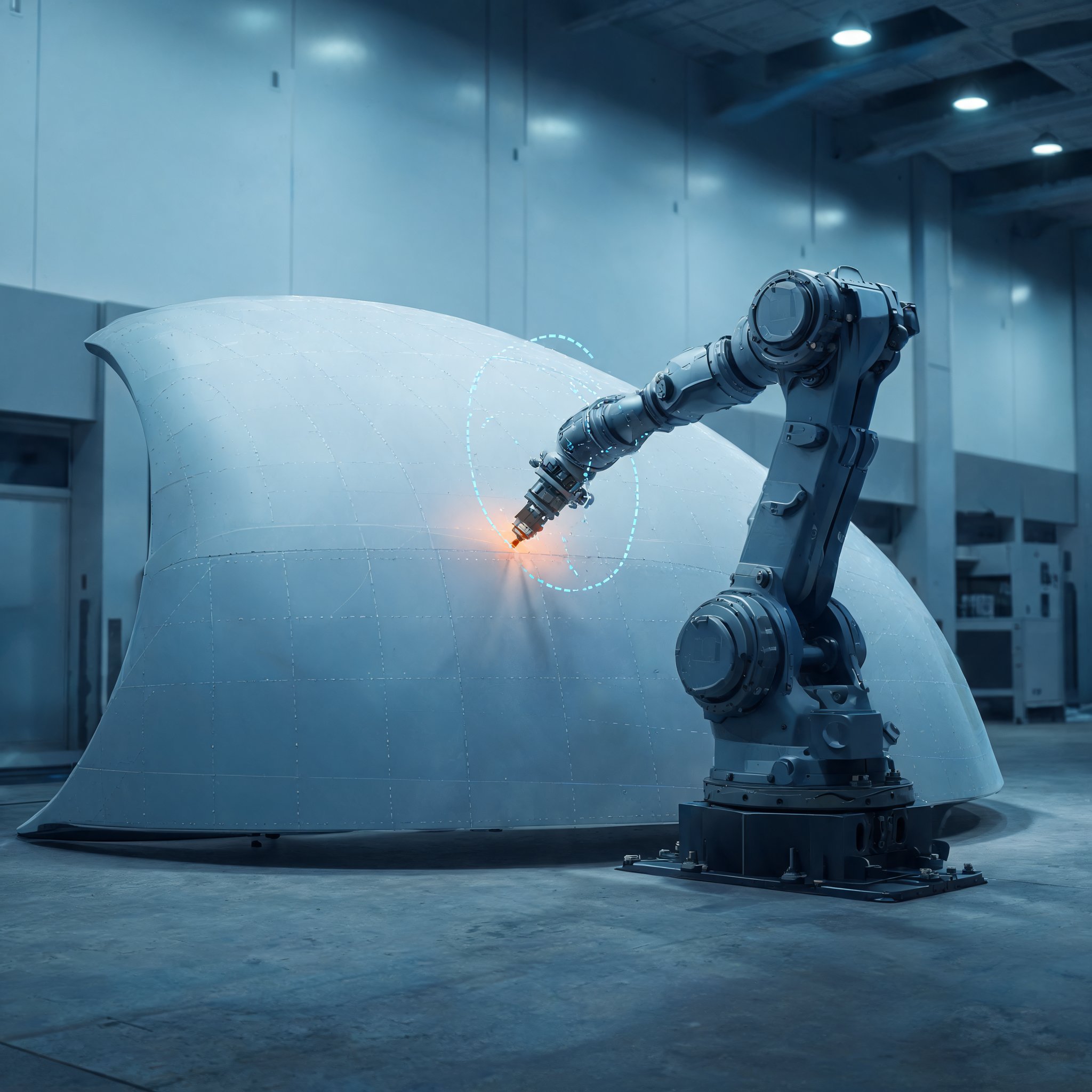
Fives High Precision Machines (Fives HPM) is positioning the Liné Machines RoboTDM as a robotic machining system for large components that do not require the full capability of a large CNC machine tool. The system mounts a spindle, toolholder and cutter on an industrial robot so that milling, trimming and drilling can be performed directly on oversized workpieces. Fives says the approach can shorten setup, simplify programming and avoid the cost and floor-space demands of a large CNC machine.
The company is targeting applications where tolerances down to approximately 0.1 mm are acceptable. Rather than moving the entire part into a large machine envelope, RoboTDM brings the machining capability to the workpiece. Fives says this can offer advantages in flexibility, cost and cycle time for suitable parts, while acknowledging that the method is not intended to replace high-precision CNC machining in every case.
Operations and applications
RoboTDM is intended for operations including face milling, deburring, removal of casting burrs and trimming of excess weld beads. It can also drill pilot holes in large aerospace panels or automotive body parts, and perform trimming, routing, drilling, edge contouring and pocketing on large composite or thermoplastic fabrications.
Fives says its development work, spanning several years of research and trials, has demonstrated cycle-time reductions of up to 70% in trimming and milling, with some individual applications achieving greater savings. The company frames the technology around a practical manufacturing question: whether an application truly needs a large CNC machine or simply requires a reliable, accurate way to place a cutting tool.
Closing the accuracy gap
Conventional industrial robots have typically achieved positional accuracy of around 0.3 mm, which Fives says is insufficient for many machining tasks. The RoboTDM development effort focused on closing that gap through high-precision robotic machining, using robot calibration together with advanced look-ahead and motion-planning algorithms.
According to Fives, these controls allow programs containing more than one million points to be processed without latency that could otherwise compromise robot motion. The result is smoother trajectory execution that supports multi-axis contouring and complex machining operations more comparable with CNC machining. Fives cites machining deviation of up to 100 μm, or 0.1 mm, a threefold improvement over conventional robotic accuracy.
Configuration and boundaries
The machining end effector can be configured with different spindle sizes, power ratings, torque and speed. Available systems can provide spindle power up to 125 kW, torque up to 80 Nm and speeds reaching 30,000 rpm, with HSK A63, HSK F63 or HSK A100 taper toolholders. RoboTDM can also incorporate automatic tool changing, tool measurement, tool-breakage detection and part probing, while a vision system can support drilling applications.
Fives says the platform is configurable for waterjet cutting, laser profiling and ultrasonic cutting as well as machining. Multiple workstations and customized peripherals can be specified, and the system’s relatively modest foundation requirements are intended to simplify installation compared with a large CNC machine tool. The company sees particular potential in aerospace, defense, maritime and energy, where components can be large and production requirements vary.
Fives is explicit about the limits. Where tolerances tighter than 0.1 mm are required, a high-precision CNC machine remains the appropriate choice, and RoboTDM is described as complementary to Liné Machines and the wider Fives HPM portfolio. The company says the product originated from customer requirements and reflects its precision at scale approach, with Fives Liné Machines Inc.’s Granby, Quebec, facility producing Liné CNC machine tools and robotic solutions and providing engineering, integration, automation, service and training support.