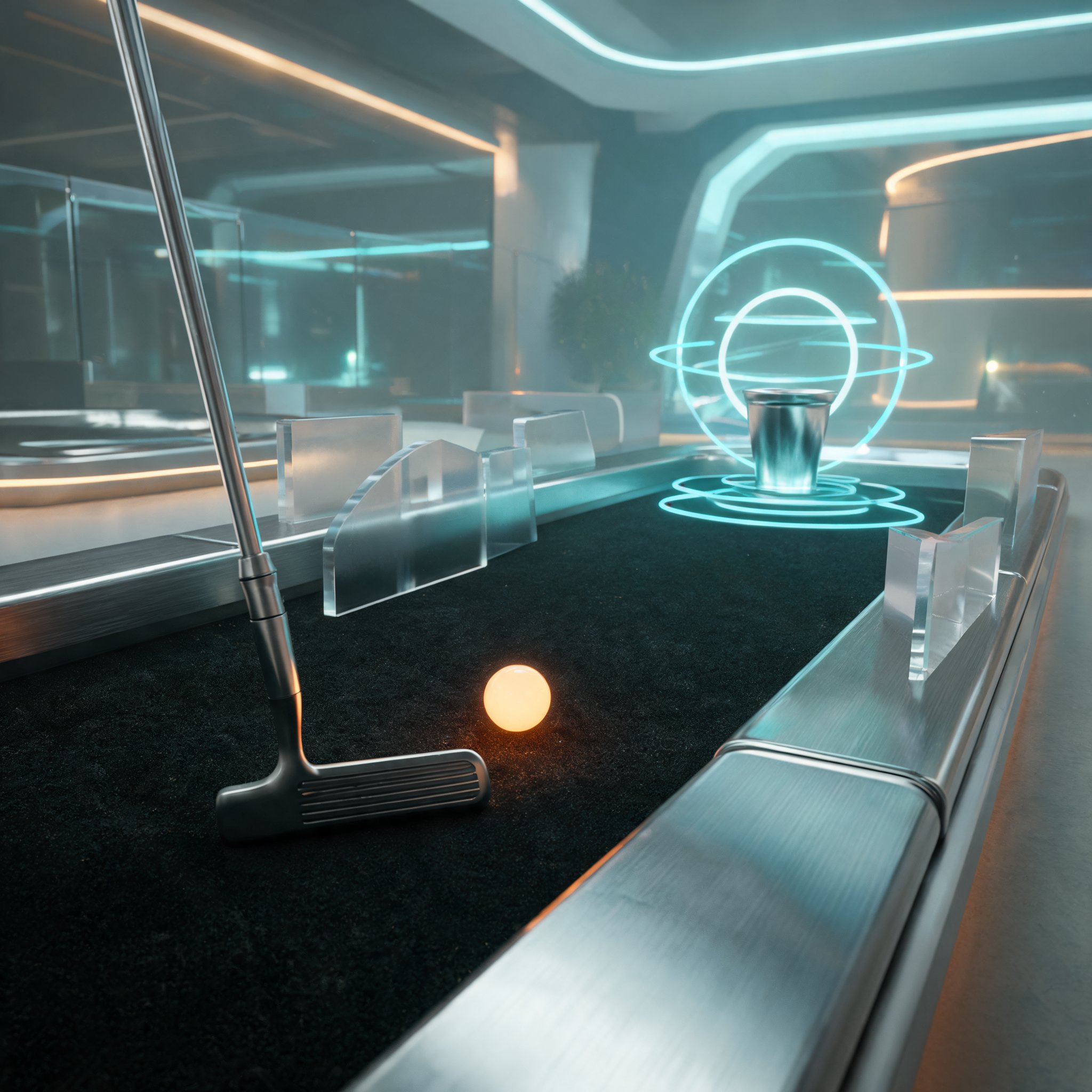
Holovis is taking its 360Golf concept beyond a technology-enhanced putting game and positioning it as a connected gaming platform for the competitive socialising market. The system combines automated scoring, gamified challenges and an AI analytics engine called DeepSmarts, and the company says implementations now span the UK, Europe, the Middle East, North America and Asia Pacific.
At its core, players register, receive an assigned smart ball and begin play with little explanation or staff involvement. Smart balls, tees and cups work with the HoloTrac scoring system to remove paper scorecards and act as an automated referee. On top of that, 360Golf layers SuperShots, Triumphs, bonuses, on-course games, player accounts, achievements, leaderboards and video celebrations. According to business development director Matt Dobbs, these features give players more reason to compete, celebrate and compare scores, and therefore to return.
Stuart Edgington, global director of business development, says mini golf’s existing accessibility means the technology can build on a familiar format rather than replace it. He describes the result as more competitive and interactive, with more measurable commercial value, and says it can appeal to families, competitive-socialising young adults and corporate groups alike.
The DeepSmarts engine gives operators information on uptime, player interaction, seasonality and possible operational adjustments. The attraction is designed to increase dwell time and secondary spend, with capacity of up to 80 people per hour per course. Dobbs says the kiosk-based flow lets guests understand the game and start quickly, leaving staff to manage guests and food and beverage service.
Installation can range from technology-only retrofits, scheduled at about six to eight weeks, to catalogue holes ready in eight to 12 weeks and fully custom courses taking six months or more. Examples include the IP-led Top 9 course at Netflix House, with themes such as One Piece, Squid Game and Floor is Lava, and the marine-grade Tee Time course for Norwegian Cruise Line, which uses rugged, waterproof, IP-rated equipment for use at sea.
At Butlin’s Bognor Regis resort, the £15m PLAYXPERIENCE indoor activity centre includes three nine-hole 360Golf courses: a neon-glow course, a Las Vegas-themed challenge and a wheelchair-accessible music-themed course. Dobbs says the venue has handled 5,000 players in a busy week and grossed around £40,000 in weekly revenue. The project also informed inclusive-design details such as right- or left-handed play, suitable putter sizes, a drop-down top cap for wheelchair access, tees placed near the edge where needed and spacing between holes to reduce crowding and safety hazards.
For multi-site operators such as Saudi Entertainment Ventures, the technology provides a common base while allowing variation in theming, layout or branding. Super Social in Leopardstown, Ireland, uses 12 holes from the sports-themed package. Smaller venues can choose a more cost-effective design while retaining scoring and replayability, according to the team.
New work includes a custom course for Lucky Duck in Norway with two play routes on each hole. Holovis is also working with Roxy Leisure to add stroke-counting technology to crazy pool tables and sees potential to apply its technology to other sports. Edgington expects competitive socialising eventually to reach peak saturation, adding that adjacent markets are under investigation.
Dobbs says interested operators should discuss venue restrictions, target audience and commercial modelling, describing 360Golf as a complete turnkey offer rather than simply a course purchase. 360Golf will exhibit at the Land Leisure & Tourism Show at NEC Birmingham on 4–5 November and at IAAPA Expo in Orlando on 16–20 November, with a playable demonstration available at its Orlando office.