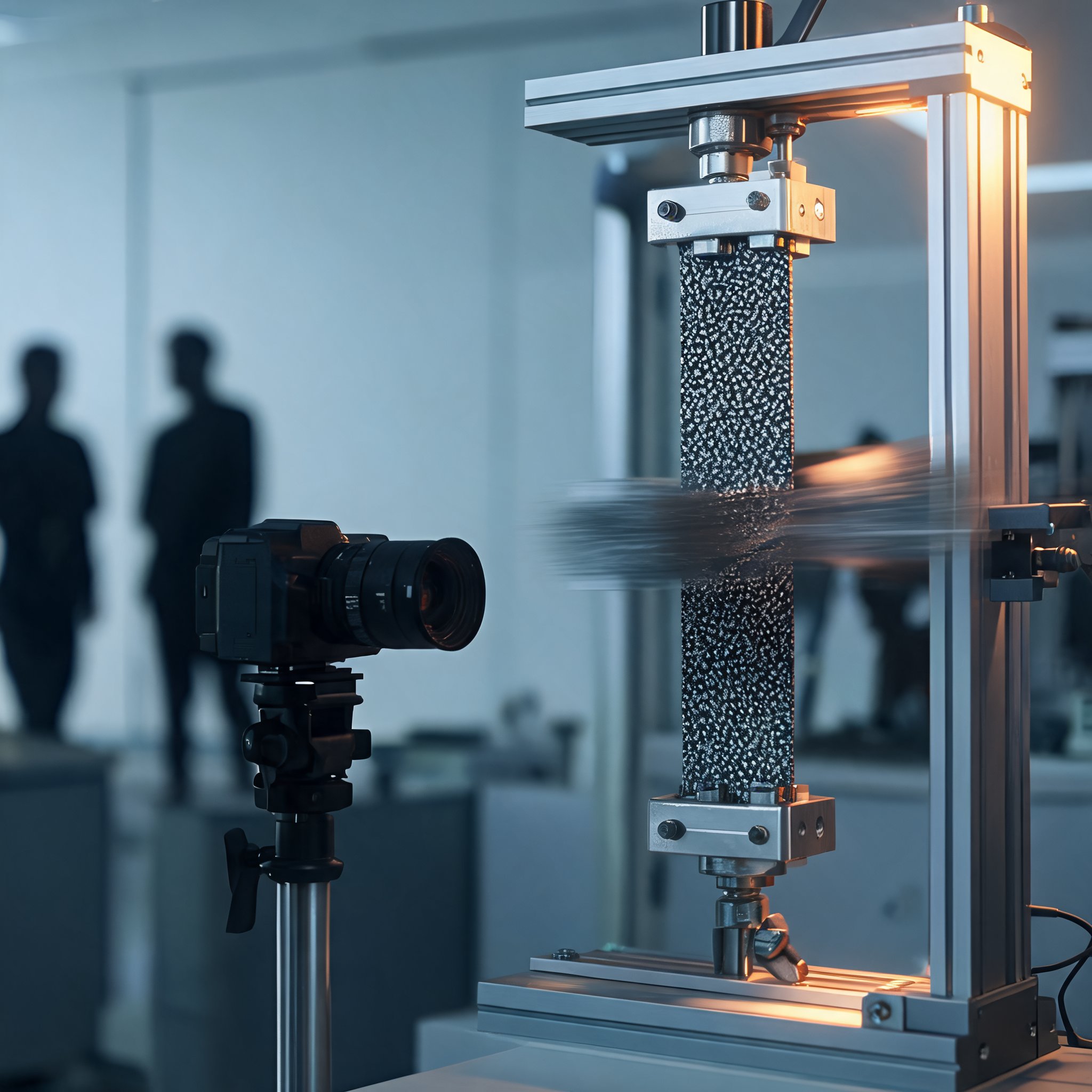
High strain rate testing can give engineers material data that is better matched to the fast loading seen in impacts and crashes, according to Instron application engineer and product specialist Andrea Incardona. The company argues that simulation is only as reliable as the material model behind it, and that conventional quasi-static test data may not capture how some materials change under rapid loading.
Why loading rate changes the model
Many materials have strain-rate-dependent behavior: strength, stiffness, deformation and failure can shift as loading speed rises. A coupon characterized slowly may therefore respond differently in a crash event. Incardona says capturing that change gives engineers a more representative basis for simulation, rather than relying only on conventional properties.
The article cites a 2025 study in SAE International Journal of Materials and Manufacturing, “Influence of Strain Rate Effect on Mechanical and Crashworthiness Properties of CFRP Composite Structures.” According to the article, adding strain-rate-dependent properties to crash simulations of CFRP structures reduced the gap between simulation and experiment. Peak acceleration discrepancy fell by 6.5%, while mean acceleration and displacement discrepancies fell by 5.9% and 6.3%, respectively.
Instron says its high strain rate characterization can cover quasi-static conditions up to strain rates approaching 1,000/s, although the achievable rate depends on material, specimen geometry and test method. Tests may last only 3 to 10 milliseconds, so data acquisition must resolve force and deformation changes within a very short window.
Material selection and early design
The argument extends beyond simulation accuracy. Incardona notes that two materials with similar conventional strength and stiffness may diverge under rapid loading. Characterizing their dynamic response allows engineers to compare how each deforms, absorbs energy and fails in conditions closer to the intended application. That matters where weight, strength and energy absorption must be balanced, such as automotive crash structures or aerospace components.
Instron positions dynamic material data as an input to product development rather than a final check. In the described workflow, engineers measure material behavior, incorporate it into simulation, use it to compare design options and then validate the chosen design through physical testing. According to the company, using rate-dependent data earlier can help teams judge material suitability and refine component designs before committing to prototypes.
Data capture requirements
Because high strain rate tests can be over in milliseconds, the measurement chain becomes part of the result. Instron says its systems support data acquisition at up to 200 kHz. It also points to digital image correlation (DIC) as a way to gather additional information on strain development across the specimen, with analysis tools supporting processing and theoretical modelling.
The company’s conclusion is that material data should be judged by its relevance to the conditions a part will face. By showing how materials respond to rapid loading, high strain rate testing can give engineers a fuller picture for simulation, material selection and design decisions. The 2025 study provides a quantified example for CFRP crash models, while Instron’s claims about its own testing and data-acquisition capabilities describe the company’s offered equipment rather than independent results.