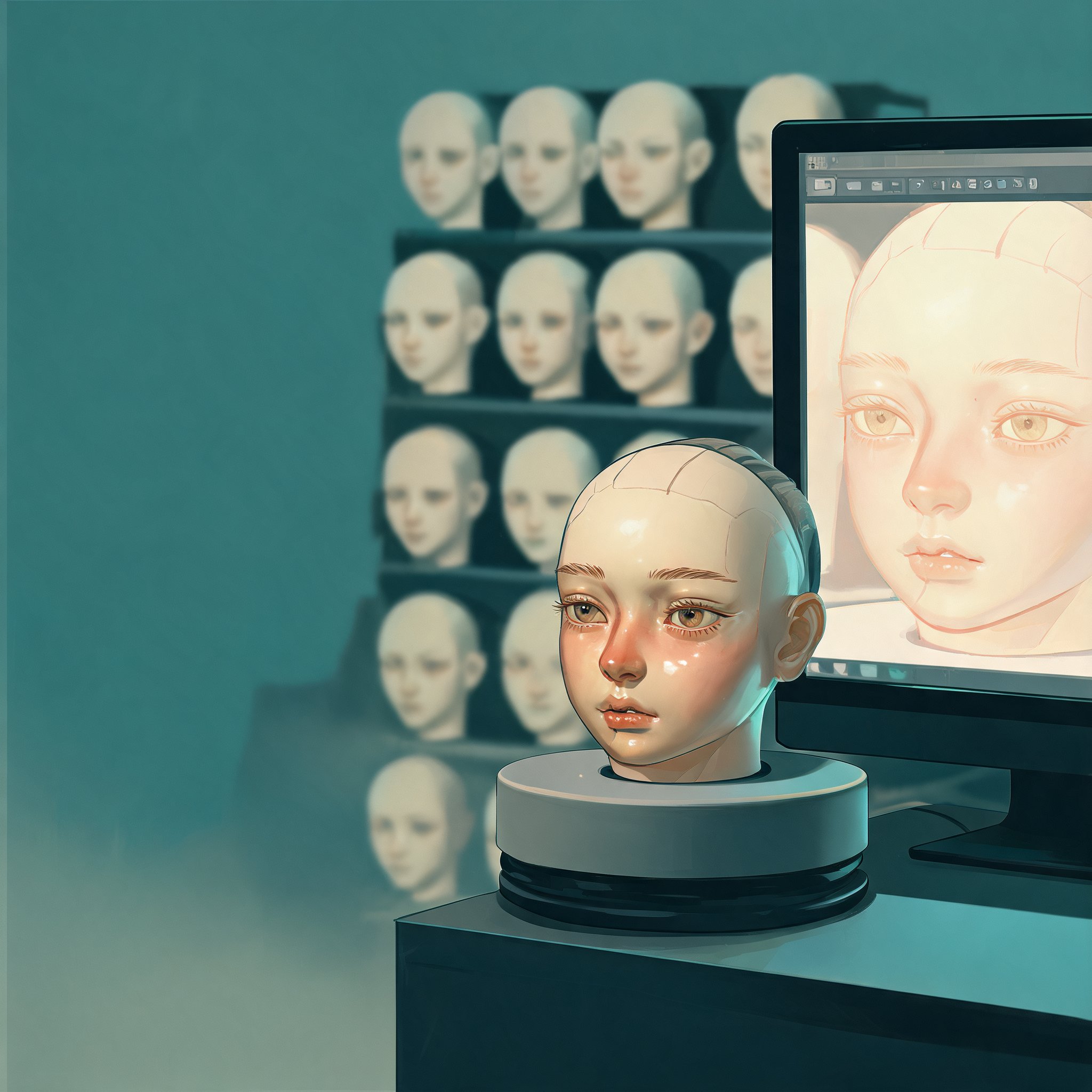
Stop-motion studio LAIKA has signed an agreement with Prague-based software developer Additive Appearance to add its PrismSlicer renderer to the 3D printing tools available to the studio's artists. The software estimates how color and translucency will look in a PolyJet print before a part is produced, with the aim of a predictable match between a digital design and the physical object.
The arrangement targets a recurring problem in full-color 3D printing: what appears on screen does not always translate to the printed part, and each mismatch can mean another print. LAIKA produces hundreds of thousands of detailed faces for every film, so reducing those extra rounds bears on both production time and quality assurance.
Founded in 2005 outside Portland, Oregon, LAIKA received a Scientific and Technology Oscar in 2016 for its work in 3D printing. Its newest feature, Wildwood, opens on October 23, and the studio said it selected PrismSlicer with future productions in mind.
Previewing appearance before printing
PrismSlicer generates an initial preview of a model's color, translucency and surface appearance ahead of printing, including under LAIKA's custom studio lighting environments. "PrismSlicer has the potential to give our artists predictive previews of their digital designs in our custom studio lighting environments," said Robert Ducey, Technical Supervisor at LAIKA. He described reliable, fast renders as a potential significant reduction in development time and a route to faster iteration when developing assets for full-color 3D printing.
Additive Appearance's initial projections indicate the visualizations could lower the number of print iterations and raise artist satisfaction through quicker feedback. Those are stated expectations rather than measured results from the studio.
Seven-month evaluation against production criteria
The collaboration was assessed over a seven-month trial against production criteria. During that period PrismSlicer gained a command-line interface (CLI) to support automation, and its simulation backend received new features intended to make renders more realistic.
Research roots at Charles University
Additive Appearance is a spin-off of Charles University in Prague, and its team is made up of engineers and researchers. The partnership with LAIKA builds on years of joint development and material research carried out with the university's Computer Graphics Group, work that addresses two problems: optically measuring the materials used in PolyJet 3D printing, and precisely matching photographs to renderings. The company says it designs its tools to work with a wide range of hardware platforms and for users across different industries.
"Their trust validates our mission to make full-color 3D printing as predictable and expressive as 2D imaging," said Tobias Rittig, CTO at Additive Appearance.
Earlier attempts to match digital color with PolyJet output
LAIKA has worked on appearance fidelity in PolyJet printing before. For Missing Link, the studio combined Stratasys J750 printers with the Cuttlefish 3D printer driver from the Fraunhofer Institute for Computer Graphics Research to print more than 106,000 facial expressions. Brian McLean, then LAIKA's Director of Rapid Prototype, attributed that choice to the software's color consistency and geometric accuracy. Cuttlefish is a voxel-based driver that works with multiple printing materials at once and accounts for light dispersion, hue and surface texture.
Stratasys approached color mismatch from another direction in 2019, when its J735 and J750 PolyJet printers received Pantone validation. The Pantone Matching System was integrated into the printers' workflow so designers and product developers could select colors from a shared reference palette and avoid misinterpretation, which shortens production time. That method standardizes color selection against a reference, whereas PrismSlicer renders how a specific model will look once printed.
With PrismSlicer, LAIKA adds a simulation step ahead of printing to a face production process that has previously drawn on specialized appearance software. Both teams expect the collaboration to lead to further work in full-color 3D printing, including new ways to combine digital and physical workflows in creative production.