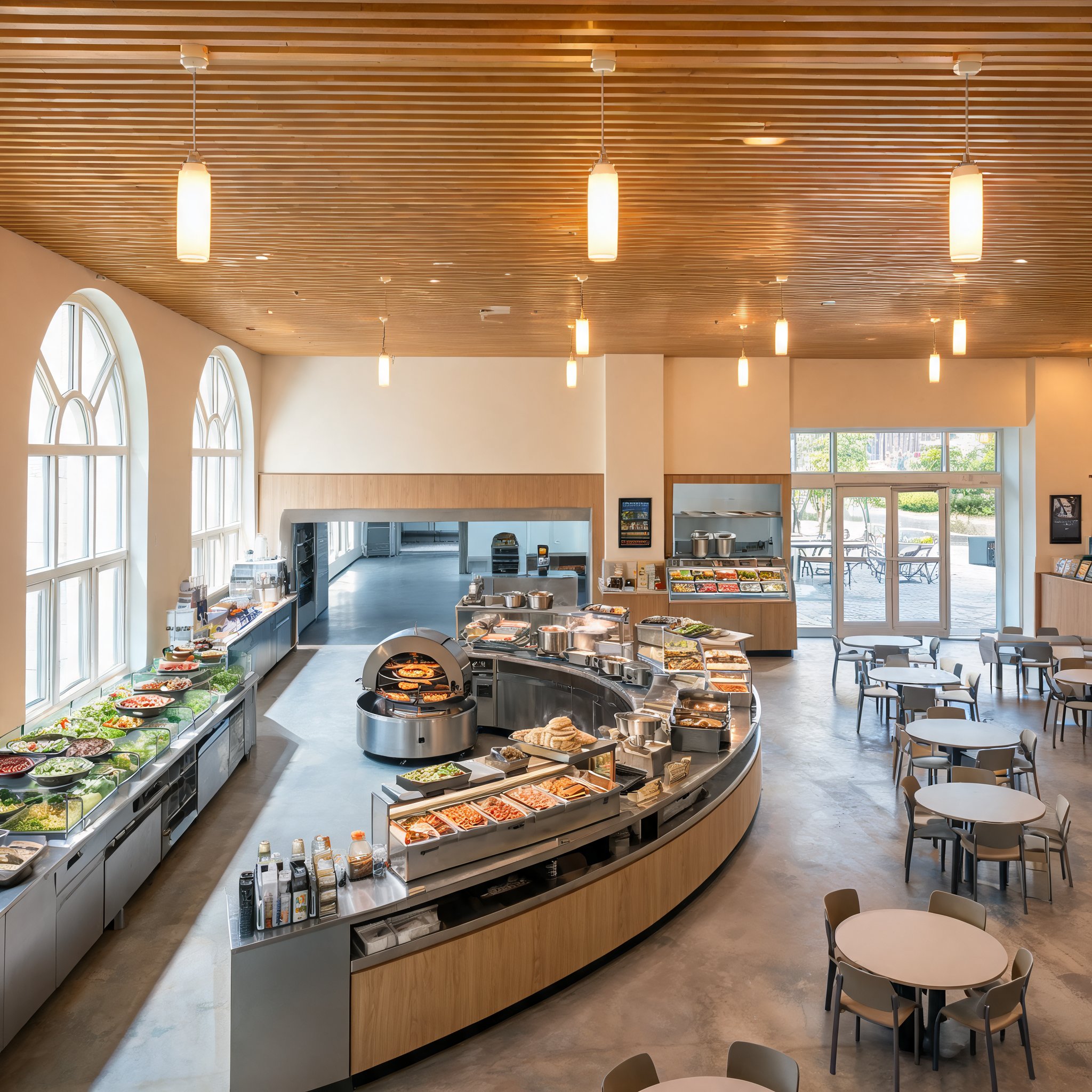
Texas Christian University has reopened its nearly 18-year-old Market Square dining facility as BLUU Dining, a redesigned hall in the Brown-Lupton University Union that the university says has already drawn record guest counts and roughly doubled daily meal volume.
The project had two stated goals: create a destination dining spot for TCU students and increase meal-plan participation to keep pace with anticipated university growth. BLUU Dining opened in August 2026 as part of a $17 million overhaul of the union. The dining hall covers about 13,000 square feet, with another 4,500 square feet for food platforms and back-of-house areas. It seats 550 inside and 120 on a patio, and includes eight food platforms plus a to-go window called Dash.
Within less than two months of opening, BLUU Dining was averaging 4,000 meals per day, according to Jude Kiah, associate vice chancellor for student affairs business and operations. That is double the meal counts recorded when the facility closed for renovation in December 2025, he said. The peak day so far reached about 5,700 meals, and Kiah said the operation could probably produce 8,000 meals per day if pressed.
Planning began in 2022 with surveys and focus groups intended to measure student satisfaction with the old Market Square. Kiah said the data pointed to the facility, not the food, as the main source of dissatisfaction. Students saw the previous hall as a self-serve cafeteria with premade food. The research also found that students valued made-to-order food over speed of service and were willing to wait for customized meals. Kiah said the team conducted at least six surveys before trusting the results.
The design responds to that finding with finish-to-order platforms and a layout meant to keep queues moving. Kiah described a line for bowls that was 15 people deep, with the last customer served in four minutes and 30 seconds.
Layout and service changes
One major change was moving the salad, deli, and to-go platform away from the main servery area to give the remaining platforms more room. The new location sits near a wall of windows overlooking campus and the stadium, and Kiah said it has become the most popular space in the facility.
The Dash to-go window opens into the entrance hallway, allowing time-pressed students to pick up a premade sandwich or salad without entering the servery. Kiah said the window gives students more options and could allow late-evening operation with little added labor.
Back-of-house circulation also changed. Miles Oller, director of facilities and operations, said the previous servery had a narrow passageway that felt like an afterthought. The new service hall has individual entrances to every platform, reducing competition for space. Oller said the front-of-house transformation is visible, but the core of the renovation is the ability to move product safely and efficiently behind the scenes.
The support kitchen received a one-for-one replacement of most equipment after the team removed old tile flooring and installed epoxy flooring. A new 800-square-foot walk-in cooler lets staff roll pallets directly into the cooler, unload them onto carts, and route products to their destinations. Scott Majestic, Sodexo district manager, said the goal was to streamline receiving and distribution.
Equipment choices favor reliability
Equipment decisions weighed capacity, flexibility, maintenance, and training needs. A rotating pizza oven, for example, can produce 116 pizzas per hour; Oller said one worker can load from the front while another unloads from the side, avoiding the need to reach into a 550-degree oven. Other selections include a customer-facing soft-serve machine, a round griddle that doubles as a plancha, and a pasta station that can shift to breakfast items.
In general, the team favored low-tech, durable equipment over computer-controlled units. Oller said he prefers “tanks” that keep working without requiring advanced training. He also noted that maintenance history influenced choices, including avoiding a griddle brand and a warewasher brand that had been difficult to repair locally. The university’s equipment service company researched repair-part prices to estimate future maintenance costs and longevity.
TCU opened East End, a dining hall on the opposite side of campus, in January 2025. The same team led both projects and used that experience to be more assertive about what it wanted for BLUU Dining. Menus draw on Sodexo’s One & All higher-education program. Meal-plan enrollment currently stands at 6,300, with expectations of surpassing 8,000 in the coming year. TCU also plans to add 2,500 beds on campus next fall.
The design team included Kiah, Oller, and Majestic, with Webb Foodservice Design as consultant and CannonDesign as architect. Kiah said BLUU Dining needed to have “some gravity” compared with East End and is doing so. “Now we just have to operate it,” he said. “It’s off to a very good start.”