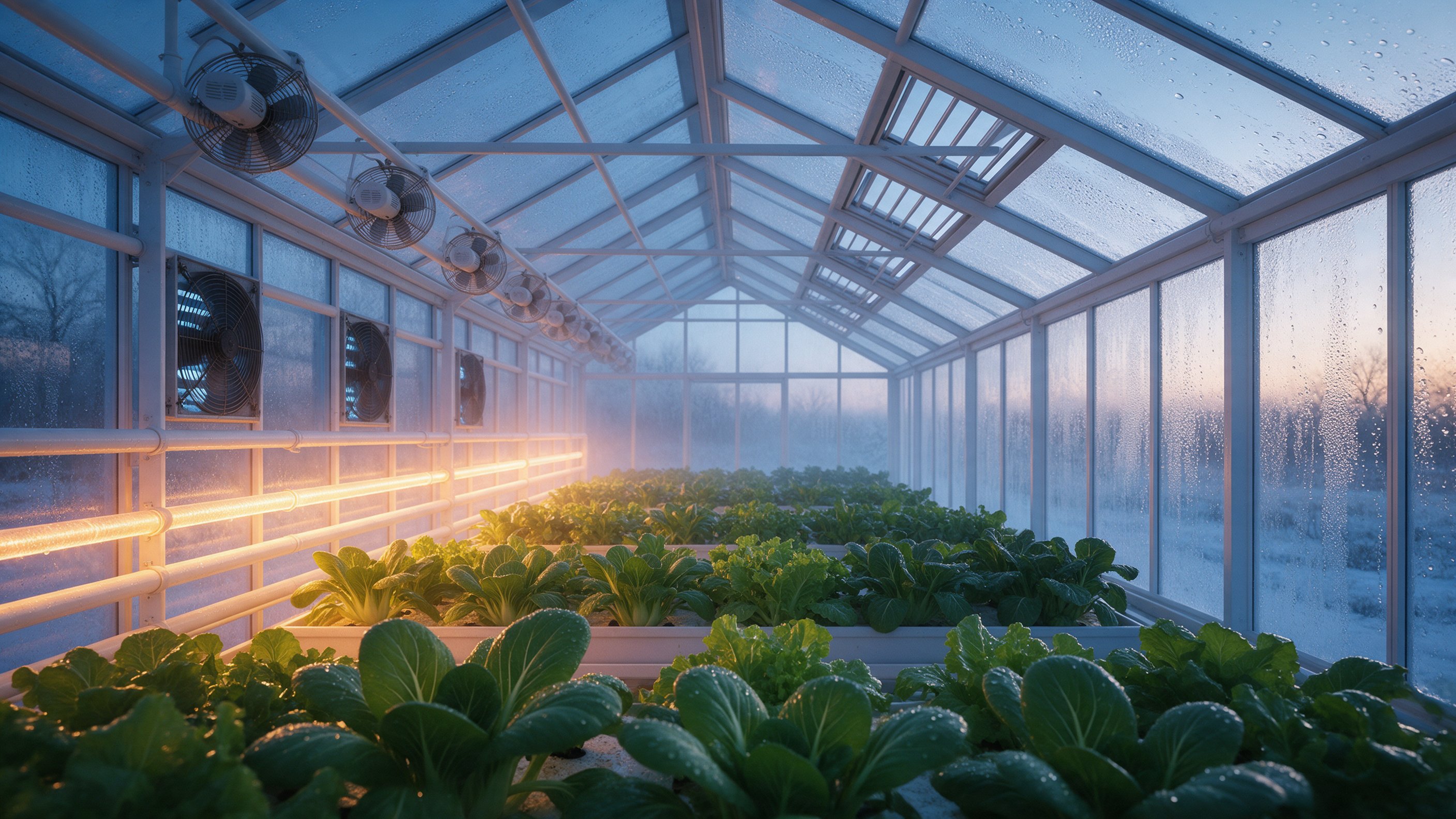
As temperatures fall, greenhouse growers close structures to keep heat in, but that makes humidity harder to manage. Excess moisture can condense on plants, extend leaf wetness, create uneven temperatures and increase disease pressure. Opening vents too widely to dry the air can waste energy and cause sharp temperature swings, so the practical task is to balance heat, ventilation and air movement.
Relative humidity by itself is not the deciding factor. Condensation forms when plant surfaces or greenhouse components cool to the dew point of surrounding air—the temperature at which relative humidity reaches 100%. In cool weather, glazing, structural parts and crop surfaces can be cooler than the air, allowing free moisture to collect on leaves. That is why the guidance frames humidity management around preventing condensation and leaf wetness, rather than hitting one RH set point.
The guidance therefore treats humidity control as a set of interacting conditions rather than a single set point. Surface temperature, air temperature, moisture released by crops, air mixing and outside conditions all affect whether water forms on leaves. A strategy that watches only relative humidity can miss the condensation risk that builds when surfaces are cooler than the surrounding air.
Dew point and nighttime moisture
Warm air holds more water than cool air. During the day, crops and growing substrate release moisture through evapotranspiration. As temperatures drop overnight, relative humidity rises and condensation risk increases. Because greenhouses are usually closed to conserve heat in cold weather, moisture can build up inside. Without enough air movement and ventilation, the air can approach saturation by morning, especially in cool, stagnant zones.
Heat and vent as a coordinated cycle
Heating and venting may look like opposite actions, but the two can work together. Heating raises air temperature and lowers relative humidity, giving moisture on plants and surfaces a chance to evaporate. Ventilation then exchanges warm, moisture-laden greenhouse air with cooler outside air—a process described as “burping” the greenhouse. Used strategically, heat-and-vent cycles can remove moisture while limiting the energy loss that comes from leaving vents open for long periods.
Microclimates and airflow
Greenhouse climates are rarely uniform. Cooler, more humid microclimates can develop near sidewalls, corners, doors, curtains and crop canopies. Horizontal Air Flow fans help mix air through the greenhouse, reducing temperature and humidity differences among those areas. Consistent air movement also supports evaporation from plant surfaces.
HAF fans alone do not remove moisture from the greenhouse. When moisture levels become excessive, air movement must be paired with appropriate ventilation. The article notes that more detail on cold-weather humidity management, environmental controls and balancing energy load is available in Ball Seed’s Technical Services blog.